What Is Google AI Mode, and What Does It Mean for SEO?

Artificial Intelligence is one of the most talked-about topics on the internet today, with new AI tools seemingly appearing every week. On July 28th 2025, in the UK, Google released an “AI Mode” directly into the SERP experience, a change that has been described as “going beyond information to intelligence”. Even in its infancy, Google AI Mode has already begun to reshape how people ask questions and receive results on the popular search engine.
This article will explain what Google AI Mode is, summarise what we know so far, and - most importantly - assess what it means for SEO and how businesses should respond to this new search experience.
Key Takeaways
- Google AI Mode is a search experience that surfaces concise, synthesised answers from across the web, not just traditional blue links.
- SEO must turn to AI-friendly content (short, self-contained answers, FAQs, checklists) that can be reliably pulled into AI results.
- Structured data, clear snippets, and E-E-A-T become even more critical to help AI find and trust your content.
- This is evolution, not extinction; classic SEO signals still matter, but winning requires deeper planning across content, formats, and user intent.
What Is Google AI Mode?
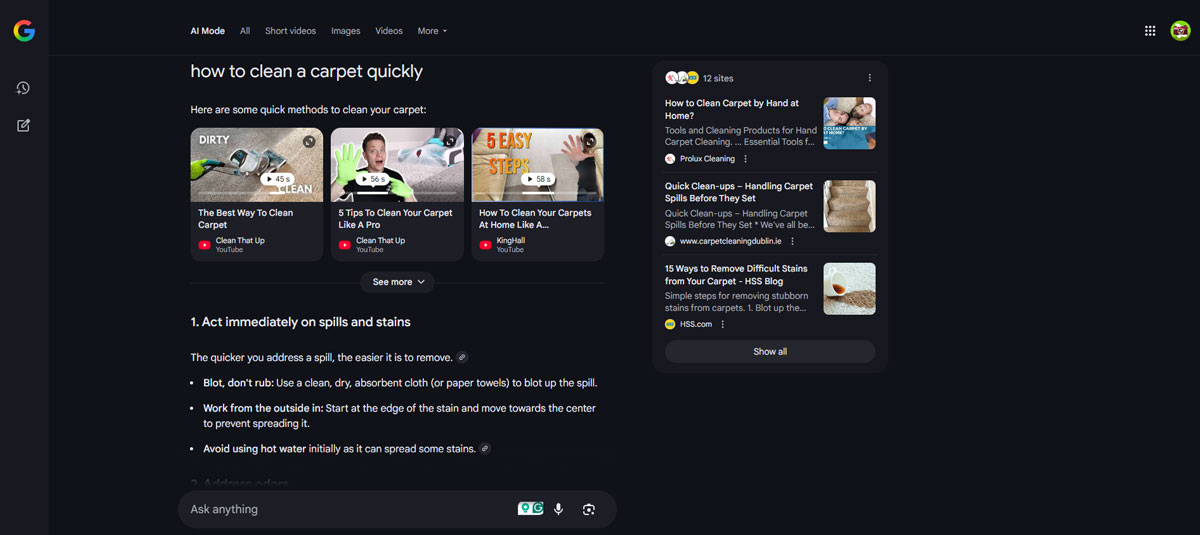
Google AI Mode is a new search experience that uses generative AI to provide direct, conversational answers within Google Search results. Instead of only showing a list of blue links, it synthesises information from across the web using Gemini 2.5’s advanced reasoning, large language models (LLMs), and retrieval techniques. This allows Google to surface concise AI-written summaries, multimodal content (text, images, videos), and follow-up conversational responses directly on the SERP.
Key Components of Google AI Mode
- Generative Snippets: Short, composed answers (sentences, lists, checklists) that combine facts from multiple sources.
- LLM-Powered Query Understanding: Large language models interpret intent, reformulate queries, and support conversational follow-ups.
- Multimodal Output: Answers can include images, tables, or other media as part of the synthesised result.
- Context Retention: The system preserves conversational context across follow-up questions for refinement.
- Structured-Data Integration: Schema, clear micro-answers, and well-marked content improve discoverability and trust signals.
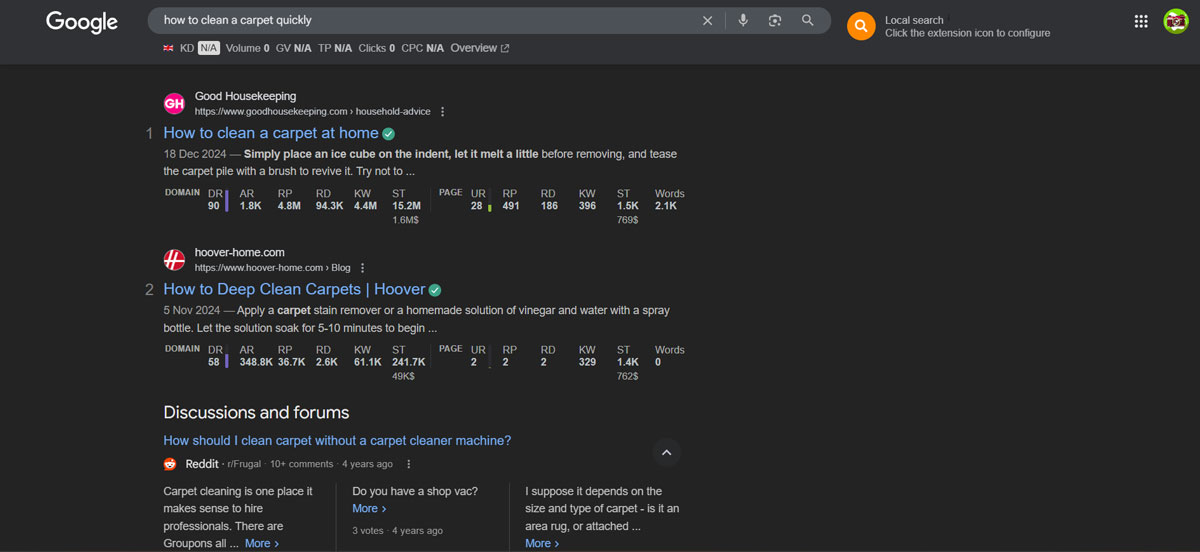
Traditional Google Search Results
Google AI Mode Search Results
Google AI Mode vs AI Overviews
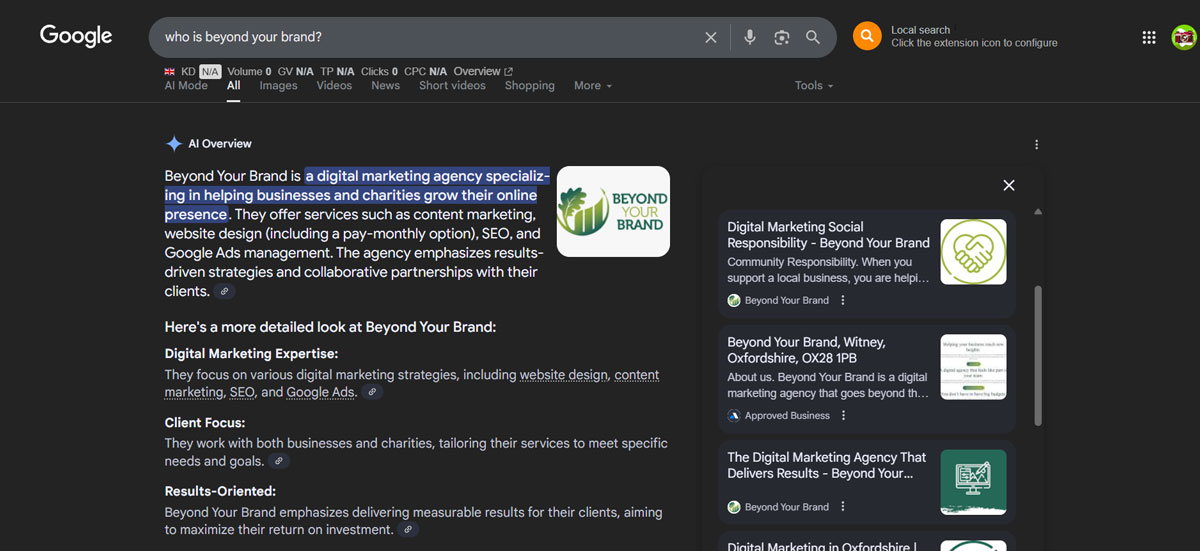
Although Google expanded its AI Overviews with Gemini 2.0 to produce richer summaries of web results, these overviews remain essentially a “summarisation layer”; they assemble and condense content into a quick snapshot for straightforward queries. AI Overviews tend to pull together existing answers and present a concise synthesis, useful for simple fact-finding or a fast overview of a topic. However, they don’t change the interaction model or the degree of reasoning behind the response.
AI Mode, by contrast, was built to go further in response to users asking for deeper, more conversational AI help, thanks to Gemini 2.5. It combines data retrieval with stronger LLM reasoning, keeps conversational context for follow-up questions, and supports multimodal inputs and outputs (images, tables, step lists) so it can tackle complex, multi-step, or ambiguous queries.
In summary, AI overviews sharpen summarisation, whereas AI Mode restructures the SERPs into an interactive, synthesis-first experience that can think through harder problems and present richer, reusable answers.
SEO in the Age of Google AI Mode
Google AI Mode refocuses SEO toward instantly valuable, bite-sized content. Rather than rewarding only full-length pages, the system often pulls single sentences, stats, short checklists, or one-line how-tos from many sources and stitches them into a synthesised answer. That means visibility increasingly favours content that can be retrieved and reused as a standalone unit, like a concise FAQ response, a clear step in a how-to, a short definition, or a compact table.
Businesses that create precise, question-driven content will outperform competitors still chasing old tactics. Write for specific user intents:
- Answer the question up front
- Keep the response self-contained
- Surface the key fact or step early (use headings, bullet lists and short lead paragraphs)
These precise answers should still sit inside useful, authoritative pages, but they must also work independently so an LLM can lift them straight into a synthesised result. This approach isn’t just a workaround for AI Mode; it’s good SEO practice generally. After all, clarity, structure, and usefulness have always helped with rankings and user experience.
Will Google AI Mode Signal the Death of Traditional Search?

No, it will reshape search rather than kill it. AI Mode adds a synthesis-first layer to the SERPs, but in-depth articles and specialised resources remain essential for deeper research and more complex tasks. Different queries demand different interactions: many users will be satisfied with a quick AI answer, while others will click through for nuance, comparison, or transaction.
Traditional ranking signals (site authority, links, page architecture) won’t vanish; they’ll sit alongside new signals that reward extractable micro-content, structured data, and clear origins. In short, AI Mode is the next chapter in search’s evolution - winners will optimise for both immediate, machine-readable answers and the richer, link-driven experiences users still need.
10 Actionable SEO Strategies for AI Mode
Building on the previous section, here are practical, high-impact steps you can take now. Each is focused on making your content extractable and trustworthy so it’s easy for AI search to find, separate, and surface your answers:
- Craft Concise, Self-Contained Answers: Write short lead answers that stand alone, like short how-tos (1 to 3 lines) or bulleted checklists. Put the core response at the top of the section so an LLM can lift it without extra context.
- Write for Conversational, Human Intent: AI Mode is conversational and expects users to engage with results like they're turning to a knowledgeable assistant. Tailor your content accordingly by answering likely follow-up questions, using a natural, helpful tone, and addressing multiple intents (informational, commercial, transactional) with separate sections.
- Optimise for Entities & Topics, Not Just Keywords: Cover the “who”, “what”, “when”, “where”, and “why” around a subject. Use clear entity mentions (brand names, product models, official terms) and topical clusters so AI can connect the dots between content.
- Prioritise Content Freshness & Accuracy: Keep stats, dates, pricing, and legal/technical facts up to date. AI snippets privilege timely, verifiable information; stale facts reduce the chance of being surfaced.
- Modularise Long-Form Content: Break guides into short modules (steps, FAQs, definitions, tables). Each module should be linkable and readable on its own, so pieces can be reused in synthesised answers.
- Enhance E-A-T and Content Origins: Display author credentials, cite reputable sources, and include clear attribution. If AI Mode can verify your authority, your content is more likely to be trusted and used.
- Create Simple Visual Answer Assets: Produce clear tables, short infographics, and labelled images that directly answer queries (e.g. comparison tables). Multimodal outputs are much more likely to be pulled into AI Mode results.
- Design Topic Clusters and Internal Linking: Group micro-answers into cluster pages with descriptive anchor text and strong internal links. Clusters help retrieval systems find the best supporting content for a given micro-answer.
- Use Structured Data Extensively: Implement relevant schema types (FAQ, HowTo, Q&A, Product, Article). Schema helps Google identify answers, steps, and product details that can be pulled as micro-answers.
- Measure Brand Visibility, Not Just Traffic: As with AI Overviews, we expect AI Mode to further reduce clicks to your website, as users will have more complete answers to their questions directly in the results. Therefore, traditional metrics such as clicks and rankings will no longer tell the whole story. Brands should review performance around AI citations, share of voice, and brand mention frequency.
- Build Zero-Click Strategies: A zero-click SEO strategy means optimising for visibility inside search results, not just traffic to your site. The goal is to ensure your brand is part of the answer, whether through featured snippets, AI overviews, knowledge panels, or local packs.
What Will Happen Next?
Google AI Mode accelerates a shift from optimising for blue links to producing modular, machine-ready content that AI systems can retrieve and synthesise. This evolution requires a move beyond one-off tactics to “strategic orchestration”: mapping user intents to micro-assets, publishing those assets in multiple formats, adding strong metadata, and ensuring they’re discoverable by retrieval systems (including those that use embeddings).
In practice, this involves coordinating content across queries, formats (text, table, image), and vector embeddings so a retrieval layer can surface the exact unit an LLM needs to compose an answer.
The Role of SEO Experts
We believe that SEO experts will lead the transition from the old way of creating online content to the new, AI-friendly methods. Beyond knowing the tech behind Google AI Mode, they’ll create the workflows, training sets, and tooling that ensure businesses stay discoverable in a world where traditional SERPs are starting to matter less and less.
Now Is the Time to Future-Proof Your SEO Before AI Mode Becomes the Norm
Many businesses are concerned about how AI will affect them, especially when new systems seem to emerge all the time. SEO will be affected, but it will be a case of adapting, rather than discarding.
By partnering with Beyond Your Brand, our experienced professionals will adapt your SEO to the latest Google updates, ensuring you don’t lose online visibility. We remain up-to-date with developments such as Google AI Mode and will ensure your content and technical SEO are AI-ready. To learn more about how we can help you, please contact us today!

