Performance Max for Google Ad Grants

What is a Google Ad Grant?
With 64% of donors preferring to give online, your nonprofit's digital presence is key to driving performance.
As a result, Google’s Ad Grant is arguably one of the most important marketing grants for charities. Google offers $10,000 (or approx. £7,425) of free monthly advertising credit to spend on Google Search Ads. Designed to level the online playing field, Google cites numerous global success stories, like Donorschoose.org, which generated 5,000 new donations in 12 months.
However, the digital landscape is competitive, and Google ultimately aims to be profitable. As a result, Grant ads are placed at a disadvantage, commonly appearing below paid ads. Alongside Google’s increasingly strict Ad Grant Requirements and policies, managing your Google Ad Grant effectively to get the most out of your ads is more important than ever. One new way to do this is by utilising Google’s Performance Max campaigns.
What is Performance Max for Google Ad Grants?
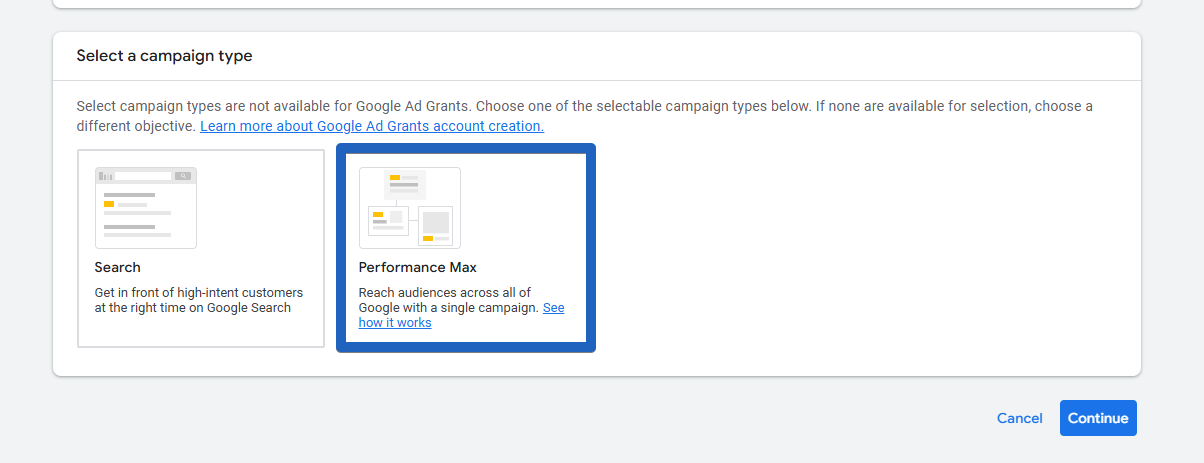
Performance Max is a goal-based campaign type that shifts away from traditional keyword targeting. Instead, it uses Google’s powerful AI to optimise its performance based on the information you provide, such as your objective (like ‘online donations’), creative assets (headlines, descriptions), and audience signals (such as detailed demographics or donor lists).
The Key Difference Between Performance Max in Ad Grant and Paid Accounts
For a standard Paid Google Ads account, Performance Max campaigns offer access to its entire network in one, including Search, YouTube, Display, and Gmail.
For Google Ad Grants, however, we’re restricted in where they can advertise. Instead, this campaign gives us access to the Google Search Network (Google Search & Google Maps ads).
Benefits of Performance Max Campaigns for Nonprofits
Showing ads on Google Maps

Performance Max campaigns make the integration of Google Maps easier than ever for Ad Grants.
For nonprofits with physical locations, such as charity shops or community hubs, local search ads offer an opportunity to boost local awareness and drive footfall.
When enabling your location asset, Performance Max campaigns automatically pull information from your Google Business Profile to place your ads at the top of relevant Google Maps search results, alongside information like opening hours and directions.
This is a powerful way to turn an online query into a physical visit.
An Exemption for CTR Compliance
One main area of Ad Grant Compliance is maintaining an account click-through-rate (CTR) of 5% or higher, with failure risking account suspension.
Recognising that the broader audience targeting of Performance Max works differently to the traditional RSAs, Google has provided an exemption. This means that the CTR of your Performance Max campaign is not counted when Google analyses your accounts' overall 5% compliance metrics.
As a result, you can leverage the wider reach of PMax campaigns without jeopardising your Ad Grant account.
Streamlining Management with Keywordless Targeting

For in-house ad management, Performance Max campaigns offer a time-effective setup.
The struggle to find high-volume keywords with manageable competition is replaced by the audience-focused approach.
This extends to ad copy, as the focus shifts from meticulously matching headlines to specific keywords to providing rich, high-quality assets. You can also utilise Google’s AI asset generation tools within the Performance Max campaign for further time-saving.
Budget utilisation
On average, Ad Grants are spending just $330 of their available $10,000 monthly budget, primarily due to limited search volume on manually-selected keywords. Performance Max is able to overcome this by widening targeting to find new search variations which you might not have discovered manually. While this is a great tool for increasing traffic, the lack of control isn’t always a positive thing, as we’ll address next.
Drawbacks of Performance Max Campaigns for Nonprofits
Lack of Control - Brand Cannibalisation and Broad Targeting

Without the control of keywords, the Performance Max campaign can default to 2 key behaviours.
Firstly, they can bid on overly broad terms that aren’t relevant to your organisation.
Secondly, they can overspend on your branded search terms. It identifies these audiences as high-performing, but in doing so, it uses your Ad Grant to capture an audience that likely would have found you organically.
To prevent these, you can regain control through 3 main features:
- Negative Keywords: a newly introduced feature for Performance Max campaigns, applying negative keyword lists to your campaign that contain irrelevant terms that you don’t want to bid on.
- Brand Exclusions: to combat brand cannibalisation, you can apply campaign-level brand exclusions lists, which remove your organisation's name and variations of this.
- New Customer Acquisition Goal: if you want to focus purely on prospecting audiences, you can set a campaign-level goal to target ‘new customers’ only. While this relies on Google’s data to identify new vs returning users, so it won’t be 100% accurate, it’s a useful way to prioritise the campaign to find new audiences.
The Need for a Trackable Conversion Action
Since Performance Max is goal-based, to work effectively and find the right audience, the AI needs a steady stream of high-value goals from your website, like completed donations or volunteer sign-ups.
Although not necessarily a drawback, in fact, tracking meaningful conversions is already a requirement for Google Ad Grant accounts, Performance Max is less forgiving of lower value data.
This means your website needs trackable conversions in place to effectively run the Performance Max, a potential hurdle that may require development work.
This also extends to the campaign-specific goals settings. If the Performance Max is left to optimise for all website goals simultaneously, it may use its budget inefficiently, chasing easier conversions (like newsletter sign-ups) instead of the more valuable one you intended (like service applications). Instead, you may need to update the campaign’s conversion goals to only include relevant user actions.
Top Tips for Managing Your Performance Max Campaign
- Provide a mix of high-quality audience signals.
These can include relevant keywords, first-party customer lists, relevant demographics, custom segments and more. - Optimise toward a high-value conversion goal.
- Provide high-quality ad copy and image assets (with the current placements, videos aren’t necessary)
- Analyse the search and audience insights.
- Utilise exclusions. Remove irrelevant search terms and exclude your brand (if it’s right for you).
- Analyse the metrics. Sure, the CTR doesn’t impact your account eligibility, but it’s important to monitor this data to understand how your campaign is performing.
- But finally, let it learn!
After launching, campaigns go through a learning phase where it’s important to avoid editing them. The length of this phase varies depending on the spend and conversions generated, but you should see the campaign’s status as ‘bid strategy learning’. Once this becomes ‘eligible’, the campaign has completed the learning phase.
Together, We Can Help Your Charity Connect with Your Desired Audience
If your charity is struggling to make the most out of your online campaigns, we’re here to help get you back on track and get you reaching your target audiences. Get in touch today to discuss how we can help your charity reach its digital goals!

